| The Anthropocene Laboratory Newsletter | | |
|
|
This is the second newsletter from the Anthropocene Laboratory, summarizing activities during the second half of the spring of 2024. |
|
|
A number of scientific, public, and artistic activities have taken place, including an international academic workshop, educational activities, participation in scientific conferences, a public seminar on the intertwined biosphere and a co-hosted seminar with international acclaimed author Naomi Klein. Scientific synthesis activities initiated during the fall of 2023 are now starting to gain traction, with multiple "products" in development, and collaboration are starting to develop with interesting partners, including the Berwald Hall, Accelerator, and artist duo Goldin + Sennerby, among others.
We welcome your comments and feedback and appreciate your interest in the unfolding activities of the laboratory. Enjoy the summer months if you are in the Norhtern hemisphere, or the winter months if you are further south. We will be back with more news shorty, after the holidays and a break. |
|
|
| | Starting the co-hoping journey | The hope project continues to refine ideas and approaches for the scientific output. We have exciting discussions here at the lab, but at the same time we seek to have more conversations about hope with those beyond our circle.
Recently, we had the opportunity to engage with 50+ educators across Europe in a Transnational Cooperation Activity event organised by the Swedish Council for Higher Education (UHR), discussing how hope could and should be integrated within the education sector. The project's researcher Dianty Ningrum also recently joined a panel session hosted by the Social-Ecological System Institute (SESI) at Leuphana University Lüneburg, talking about how hope can be used to get unstuck from polycrisis to a better future.
We have an upcoming engagement at the Baltic Sea Festival, which includes a talk and an interactive installation 'Reflecting on Hope'. The Baltic Sea Festival is one of Europe’s biggest and most important classical-music festivals. Please see below for more about the event.
We are looking forward to more engagements and collaboration with various people and institutions! | 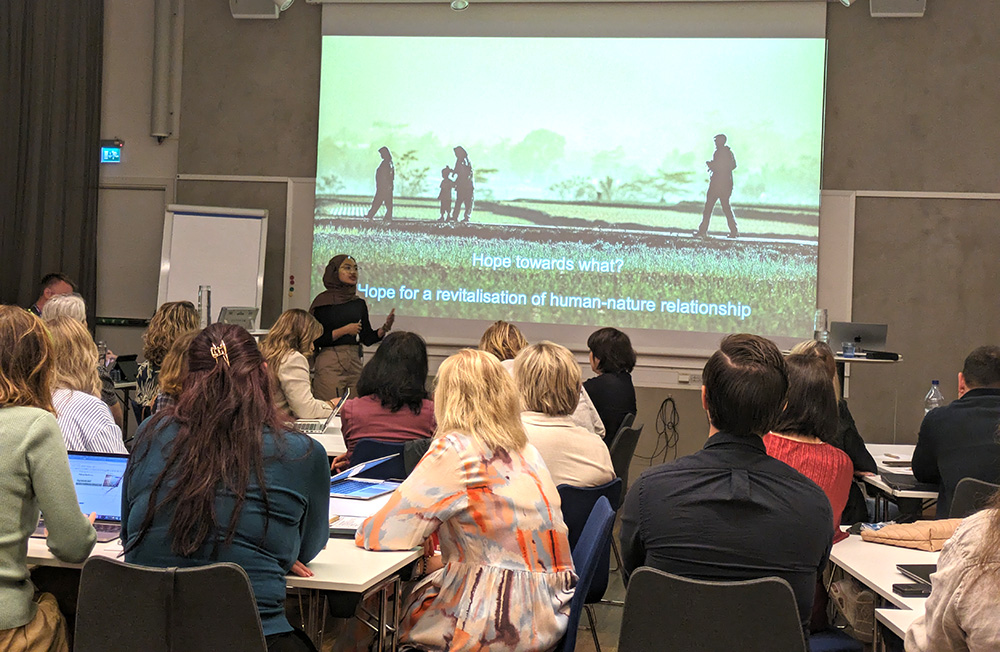 | | | Baltic Sea Festival | On August 28th scientists from the Royal Swedish Academy of Science's newly initiated international and interdisciplinary programme "The Anthropocene Laboratory" will present their research on hope and how you can remain hopeful and find the strength to work toward change.
A warm welcome to this year's Baltic Sea Festival 23rd-31st August, which opens the season in Berwaldhallen with a program where visions and dreams are a common thread.
Esa-Pekka Salonen, star pianist Yuja Wang, the Tallinn Chamber Orchestra, the Swedish Radio Choir, and the Swedish Radio Symphony Orchestra are some of the highlights of the concert programme for this year's festival. With nine days of concerts, talks, workshops and art, the festival addresses the challenges of our time and aims to bring hope for the future. This year's program is inspired by visionaries who lead the world in new directions make us look up and see new solutions, dare to dream and help us believe that a better world is possible.
The Baltic Sea Festival offers a 20% ticket discount (regular price 275 – 950 SEK). Enter the discount code “anthropocene” at the end of your purchase to receive your discount. The offer cannot be combined with other discounts and offers.
Book your ticket at balticseafestival.com | 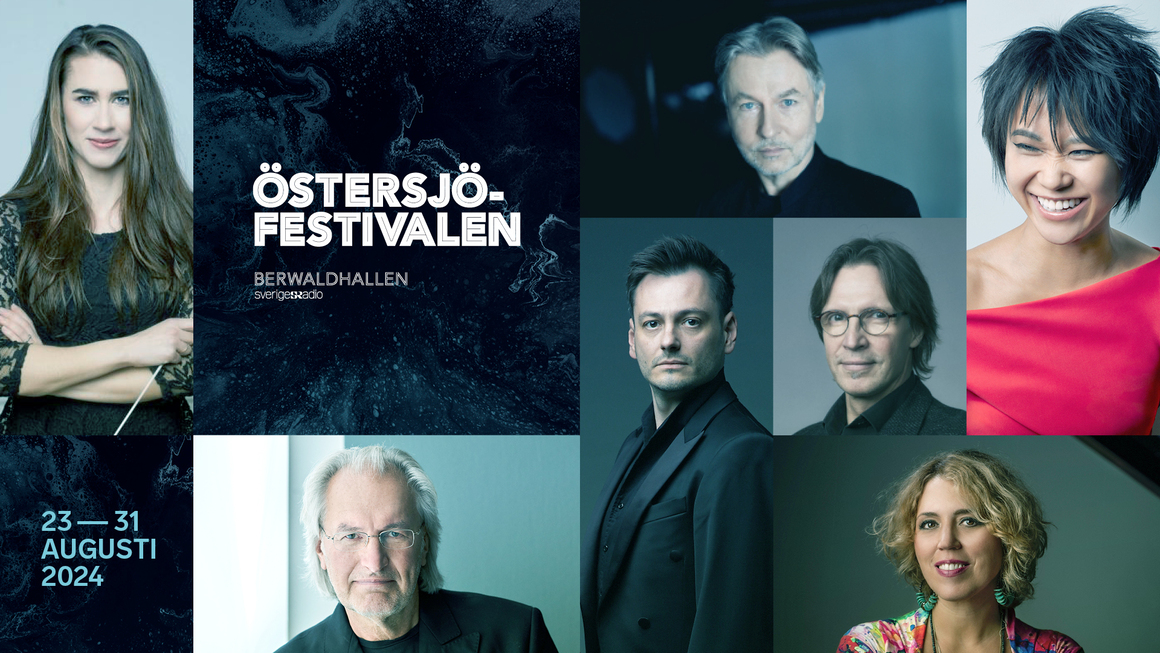 | | | Diving deeper: exploring the intertwined biosphere | In late May, the Anthropocene Laboratory hosted its first full workshop on the Intertwined Biosphere topic. Across three days, the group came together to identify research opportunities with the potential to conceptualise, and empirically investigate, humans as truly intertwined with all life in the biosphere.
Hailing from multiple continents, the 27 attendees came together in Stockholm, the group included those working within the humanities, the arts, and the natural and social sciences. On the first day, the workshop was hosted by Stockholm University’s exhibition space, Accelerator. Through presentations, lunches, and a walk-and-talk, we became familiar with each other’s motivations, interests, and research - including the many different perspectives from which ‘the intertwined’ can be studied. These perspectives were clustered in working groups allowing research proposals to be developed during the second and third days. The proposals were inspired by both group and plenary discussion, and a presentation by the artist subject Goldin+Senneby (see later in this newsletter). Over the summer period, the working groups will continue to develop their research, reconvening later in the year.
Are you looking for further reading on the Intertwined Biosphere project? Feel free to take a look at the Laboratory's Workshop Brief. | 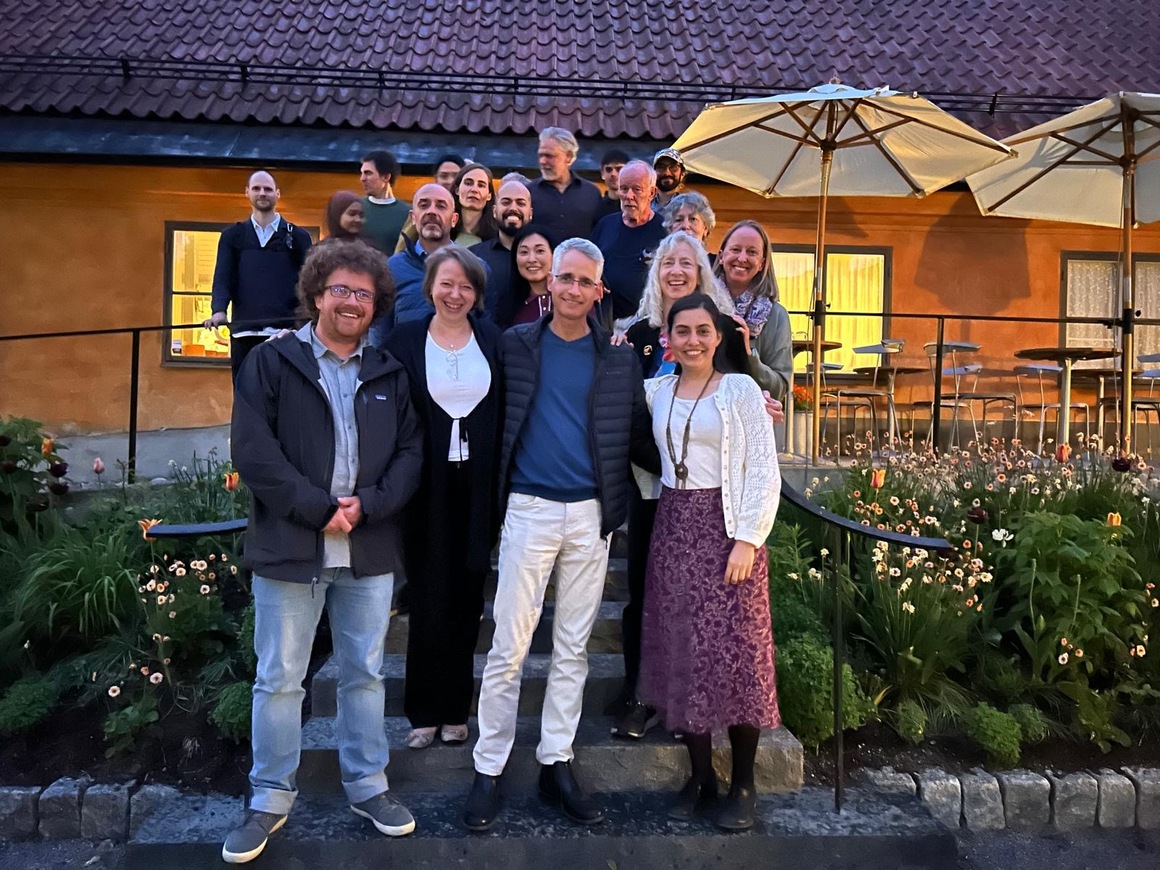 | | | A Public Seminar on the Intertwined Biosphere | The Anthropocene Laboratory hosted a public seminar on May 23rd, on the Intertwined biosphere. Featured speakers included Simon Goldin and Jakob Senneby (a Stockholm-based artist duo with which the Laboratory and partner Accelerator are collaborating), Ron Milo (a systems biologist leading a group that is defining the biomass of life), Eva Jablonka (an evolutionary biologist who has pioneered the science about epigenetics), Esteban Jobbágy (a systems thinker and agronomy-specialist), Ariane König (en expert in regenerative Social-Ecological Systems), Belinda Reyers (a leading scholar in sustainability science) and Carl Folke (founder and Chair of the Scientific Committee of the Anthropocene Laboratory). The seminar was moderated by Henrik Österblom (Director of the Anthropocene Laboratory). | 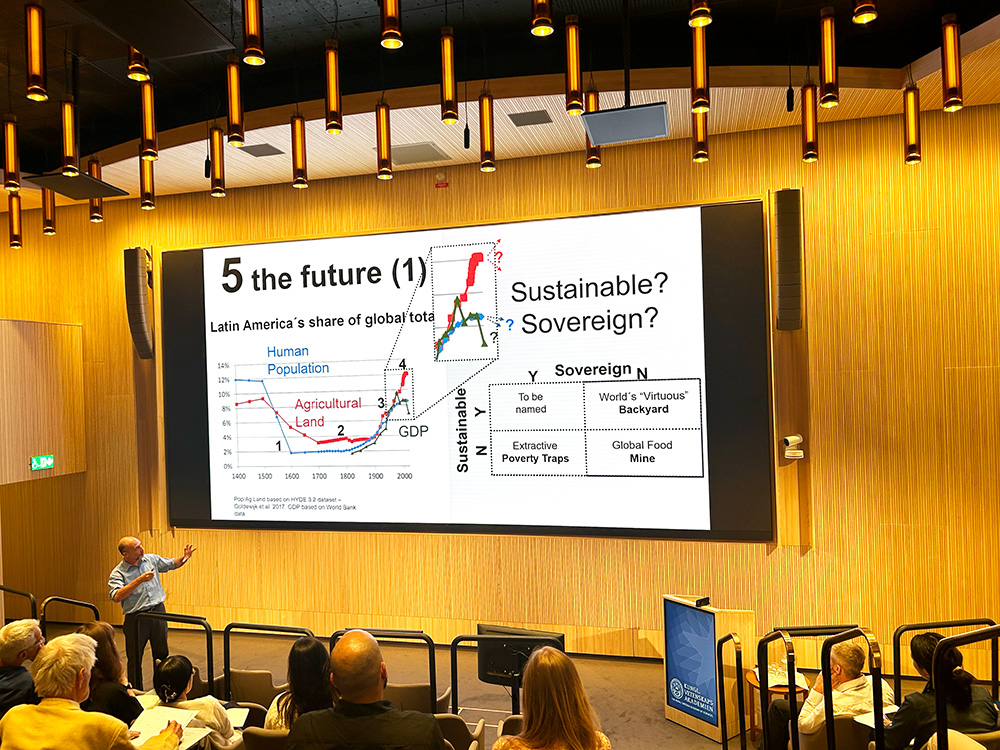 | | | | Progress in collaboration between science and art | Goldin + Senneby hosted the laboratory and Accelerator in their studio for a sneak peek of their ongoing work, combining science and art for an improved understanding of the biosphere- The shared intention is to generate a public arts exhibition in the near future. Exciting progress has been made, both with regards to the theoretical background and potential application of practical content. Two exciting proposals by the artists were discussed, and there was general excitement about the potential that lies in combining science and art – and how such meetings can inspire novel thinking. | 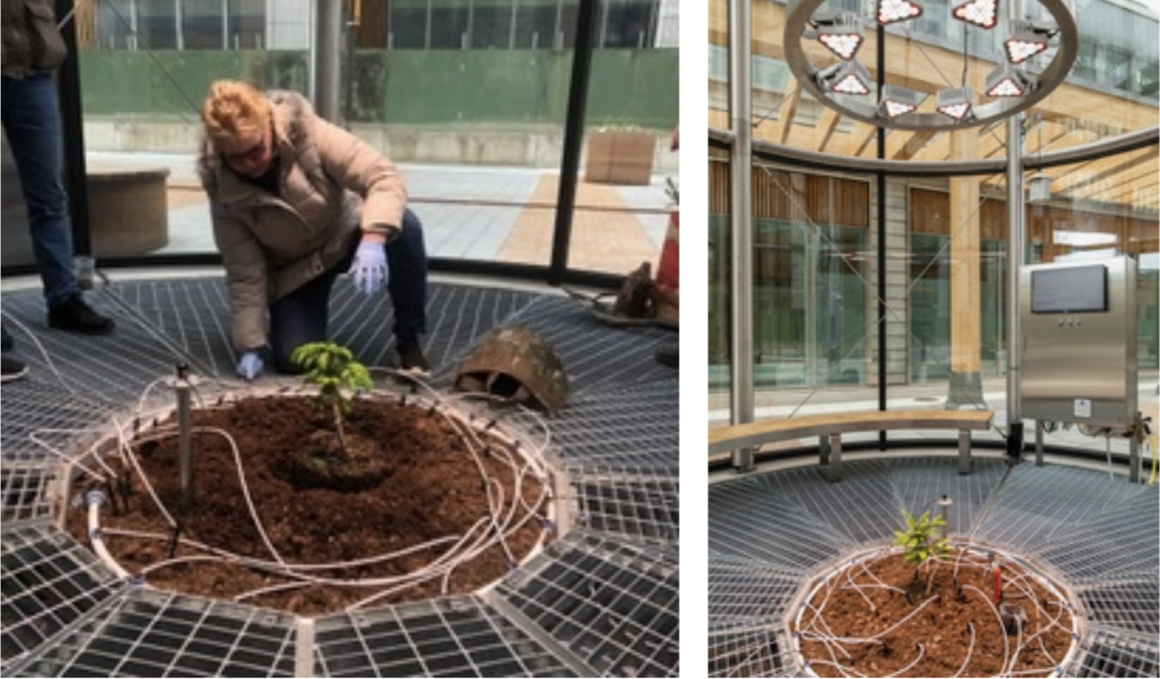 | Photos from the presentation by Goldin + Sennby in the Intertwined Biosphere Seminar
Left : Goldin+Senneby, Spruce Time (2024), planting the world’s oldest spruce at the hospital in Malmö. Commissioned by Region Skåne.
Right photo: Goldin+Senneby, Spruce Time (2024), the world’s oldest spruce has been hospitalized in Malmö. Commissioned by Region Skåne. Photo: Helene Toresdotter /Region Skåne. | | | Naomi Klein in Stockholm | In a collaborative event convened by OrdFront, Katalys, Aftonbladet, and the Anthropocene Laboratory, the author of “No Logo”, “The Shock Doctrine”, “This Changes Everything”, and “Doppelganger” attended a public seminar on May 16th at Teater Rival, Stockholm. The room was filled to the brim and featured interesting conversation about the digital reality of the Anthropocene. | 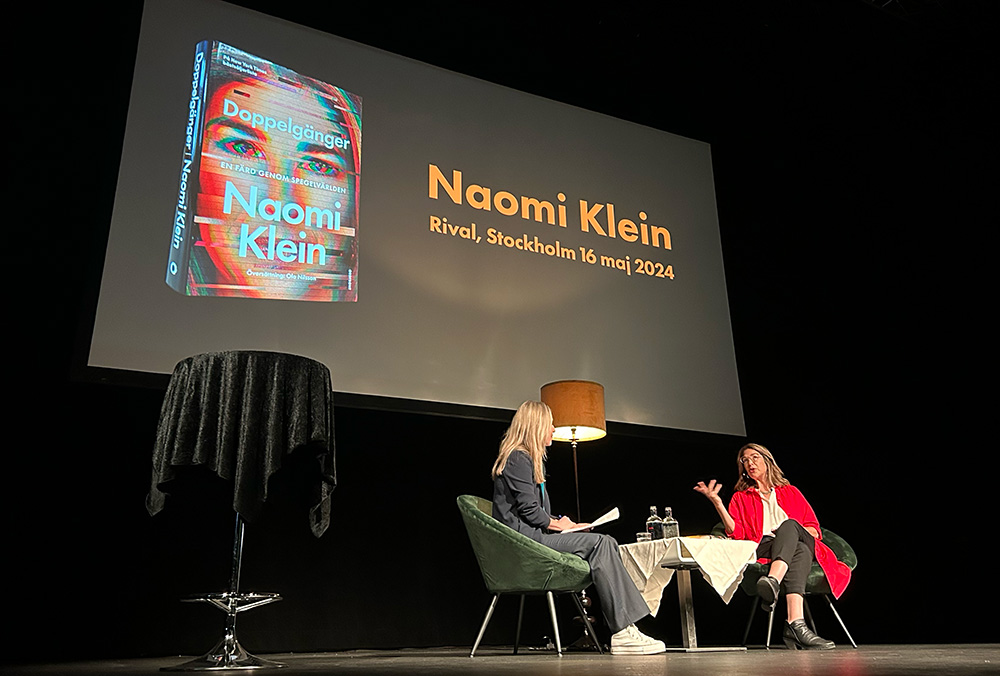 | | | | Ongoing and future collaboration with Stanford | Gretchen Daily, scientific advisor to the laboratory, hosted the Annual Natural Capital Symposium at Stanford in June. Henrik Österblom participated in, two days of discussion with government representatives and international development banks in a global forum titled “People, Planet and Prosperity”, focusing on how natural capital and ecosystem services can be better integrated into decision making and practical resource management. Several examples from diverse countries (Uruguay, Cook Island, Barbados, China, and many more) were presented. This forum was followed by a three-day scientific conference on Natural Capital, where ongoing and potential collaboration with a range of artists were presented and discussed in a joint session between the Nat Cap Project and the Anthropocene Laboratory.
The visit to Stanford also featured several conversations with representatives from the Stanford Doerr School of Sustainability, and an exploration of potential collaborative opportunities.
More information about “People, Planet and Prosperity” global forum
More information about the scientific conference | | About The Anthropocene Laboratory |  | | Vision
A revitalised anthropocene biosphere.
Mission
The mission of the Anthropocene Laboratory is to advance understandings of the intertwined biosphere, and to leverage this knowledge to identify and enable novel pathways towards a sustainable and just future. Through respectful dialogue and interdisciplinary collaboration, we explore creative approaches that integrate perspectives from the natural and social sciences, humanities, arts, and other fields of knowledge. Our aim is to catalyse positive change and inspire a future where our relationships with the living planet are revitalised.
Partners
The Beijer Institute of Ecological Economics and the Global Economic Dynamics and the Biosphere Academy Program (GEDB), both at the Royal Swedish Academy of Sciences, and the Stockholm Resilience Centre (SRC) of Stockholm University, have been instrumental in forming and developing the international frontier of science for sustainability. These organisations are critical assets for the Anthropocene Laboratory and have decades of experience in performing scientific work that combines skills and competencies across disciplines as well as science for change. These are the home institutions for the Anthropocene Laboratory mentors.
The Anthropocene Laboratory strives to work across scientific disciplines and in collaboration between science and art. We are happy to have partnered with Norwegian visual artist Tone Bjordam, Stockholm-based Accelerator and Goldin + Senneby, and Accelerator the exhibition space in Stockholm University where art, science and societal issues meet. | |
|
|
|